Case study
Agentic Calendar Assistant
An AI-powered calendar assistant that understands natural-language requests and helps users find availability, schedule, reschedule, and cancel Google Calendar meetings through an agentic workflow.
01 / Challenge
Traditional calendar applications require users to navigate through multiple screens, manually inspect schedules, and perform individual actions for creating, rescheduling, or cancelling meetings. The goal was to build a more natural interface where users could describe what they wanted in plain language while still maintaining control over sensitive calendar actions. The system also needed to handle authenticated, user-specific Google Calendar data and provide a reliable way for an AI agent to interact with calendar operations.
02 / Solution
Built a full-stack agentic calendar assistant using Next.js, React, TypeScript, Node.js, Express, Gemini, and Mastra. The application uses an AI agent that interprets natural-language requests and selects the appropriate calendar tools. The agent can retrieve upcoming meetings, check calendar availability, create meetings, reschedule existing events, and request cancellation of meetings. Google Calendar API provides the calendar operations, while Descope handles authentication and Google OAuth integration. Zod validates tool inputs, and Server-Sent Events stream agent progress and responses to the frontend in real time. For destructive operations such as cancellation, the system uses a human-in-the-loop approval flow so the user must explicitly confirm the action before it is completed. The application also includes persistent conversational memory and an authenticated MCP server for exposing calendar capabilities to compatible AI clients.
03 / Result
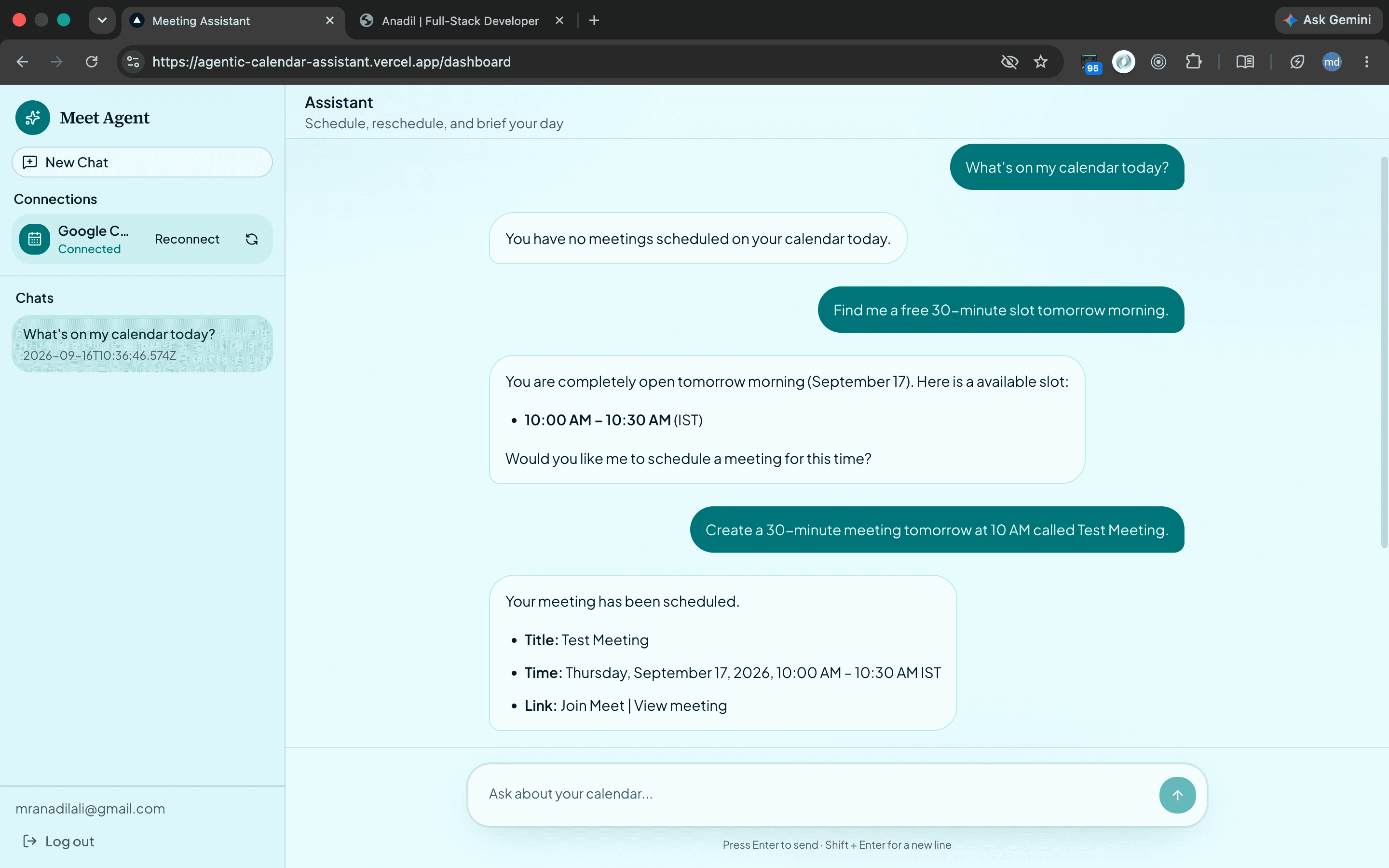
The result is a production-deployed AI calendar assistant that allows users to manage their Google Calendar through natural-language conversations. Users can ask questions such as "What's on my calendar today?", find available time slots, create meetings, reschedule events, and cancel meetings with explicit approval. The application is deployed with a Next.js frontend on Vercel, an Express backend on Render, and PostgreSQL for application data. The core calendar workflows were tested successfully in the production environment.
Product views
Technology
 TypeScript
 Next.js
 Node.js
 Express.js
 PostgreSQL
 Vercel
 Render